The Heath Crisis
Handling the UndeadThe Heath Crisis is the breakdown at the Heath in which the expanding field of consciousness overwhelms ordinary perception and helps turn fear into a force that drives the dead and living toward disaster. What begins as an inward, nearly invisible pressure becomes a public emergency: the field absorbs individual minds, panic feeds its intensity, and the Heath can no longer function as a place open to the public.
The Field and Its Escalation
At 12:50, as Flora approaches the buildings, the field thickens from the streams she sensed beyond the gates into something like fog. Within it she feels many consciousnesses present without forming thoughts, while scattered mental cries of horror remain distinct. Those cries intensify the field, in a feedback that makes fear more than a response to danger: fear enlarges the force that is frightening people. Flora experiences the effect as a crowd of minds pressing into her own, dominated by terror and despair, so overwhelming that she imagines the field should be visible in the air.
The pressure reaches beyond Flora. David’s mind is already filled with Magnus’s despair when Sture turns his attention outward and senses a rising disturbance through the field, like the sharp cracks and wavering trunk of a tree about to fall. Thousands of panicked consciousnesses merge into an indistinguishable uproar, crossed by a piercing whine. The crisis thus makes private thought porous: those caught in the field cannot easily separate their own minds from the fear around them, and the crowd’s emotion becomes part of the danger itself.
Evacuation and the Cost of the Crisis
The field turns the Heath’s internal disturbance into a mass evacuation. David and Sture have been so absorbed by what has happened to Eva that they initially miss the warning rising through the field; when Sture recognizes its ominous sound, he grabs David’s shoulder and urges him toward the gates. Their own thoughts are swallowed as they hurry out, while people stream from the buildings and run for the exit as if fleeing a fire, a war, or an approaching army. The retreat marks a lasting change in the site: the Heath will never again be open to the public.
At 13:15, the violence has ebbed enough for Flora to open her eyes. Curled on a bench and clutching her backpack, she has been unable to move while the field’s force overwhelms her; after five minutes it begins to subside, and after ten she realizes the police leaving the courtyard have overlooked her. A wounded man remains outside a door, his face scratched and his shirt collar marked with blood. As an emergency worker dresses his cuts, Flora senses his thoughts turn to his mother: even through years of illness, she had preserved a measure of dignity by keeping her nails groomed and painted cherry red. One nail is now broken from scratching him. The moment gives the crisis an intimate human scale: the field’s violence is not only a distant mass of panic but an injury carried into the survivor’s most personal memories.
The Courtyard Breach and Flight
By the time Flora returned to the courtyard, the calm outside could not disguise the cacophony in her head: cries, prayers, anger, pleas, and hatred crowded together. The legless man she had met on the stairs was still dragging himself toward the entrance. Flora crouched beside him and tried to send her knowledge into him, but he resisted, struck at her hand, and bared his teeth. His refusal turned their encounter into a collision of emotions: his wrath fed her own, and she had to master the impulse to kick him before leaving him behind. She understood that he was hungry because he had consumed his own flesh to sustain his existence; anger from outside was now driving him toward its source.
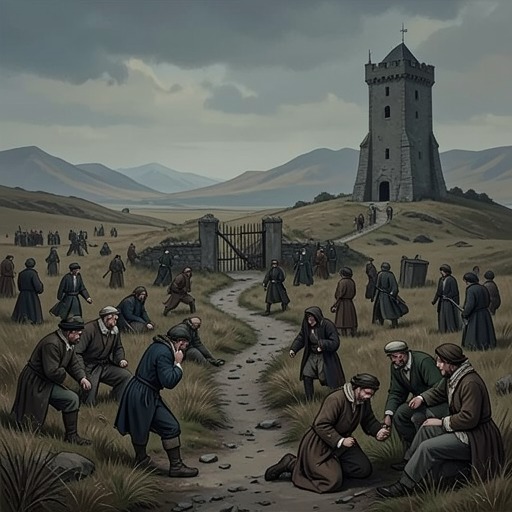
Across the courtyard, the dead had left their yards and were converging on the fence. The gates stood open as police SWAT teams drove in, officers jumping out with weapons drawn to hold the dead back. No shots had yet been fired, but the numbers made the confrontation precarious: there might have been one officer for every thirty dead. Flora ran into the mass and reached a young officer just as his consciousness gave way; she threw herself forward while he fired into the bodies around her. The dead began pouring through the gates toward the road and the city, turning the threatened clash into a breach.
Elvy and Flora were urged into a SWAT vehicle as the horde approached. For a few seconds, they could share each other’s thoughts: Elvy’s shame at having failed to understand what she should have done, and her resolve to use what she felt was her last chance to put something right. Flora, meanwhile, knew that the instant she had spent inside Death had ended any possibility of returning to ordinary life. When a man gestured toward the approaching dead, the driver accelerated. The vehicle struck the bodies with a clang, throwing them aside; through the side window, Flora saw those hit stand up again. She covered her ears and sagged into Elvy’s lap, feeling each impact through her body as the car ploughed on.
Reciprocal Escalation
The field’s danger lies in its two-way transmission: the dead affect the minds of the living, but the living also affect the dead. Emotions pass between them as if through prisms, enlarged and reflected back until each intensifies the other. The Heath’s collapse is therefore not simply a crowd of living people reacting to the dead; fear and distress become forces that circulate across the boundary between them, making the crisis self-reinforcing and ultimately unbearable.